
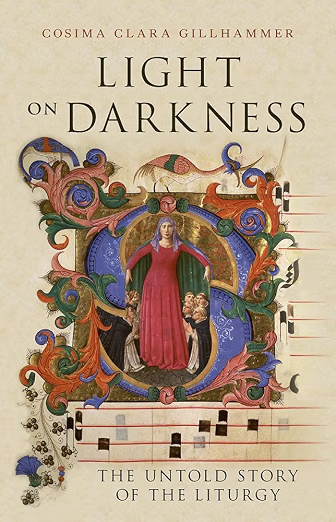
I am currently in a doctoral program, studying semiotics—cultural symbols—which requires a great deal of reading. Probably the greatest benefit of an education is the wise guide (teacher) who can give a curated tour of the best there is in any given subject, and such is the case with this program. Dr. Leonard Sweet has opened the door to an entire world of scholars and theologians who look beneath the surface of things and reveal mysteries. Now I would like to open that world to you.
Here is what has continued to hold my attention after reading this book:
“In rituals a set of common beliefs is acted out in a symbolic setting, in community with others … Rituals help members of the community internalize their beliefs. This dynamic is well documented in social psychology and anthropology for rites and rituals across cultures … ‘if one must act as though one believed one ends in believing … as one acts’”
Cosima Clara Gillhammer, Light on Darkness: The Untold Story of the Liturgy,18.
So-called low liturgy churches, then, and primitive churches that eschew the liturgical calendar, are missing something perhaps vital in passing along faith?
I continued to think about that as I read.
Beauty of Liturgy
The several examples Gillhammer gave of how the scriptures inspired art, song, poetry, and liturgy, have really brought it home for me how much of the Bible people actually knew in times past. Knew, in fact, so well, it was in their bones and sinew, in their blood, so to speak. They could not help but have that influence their art, but also occupy their daydreams and imagination.
One illustration was a breathtaking account of a man named Rupert’s thoughts on his call to the priesthood (55). Rupert spoke in reverence with the words of romantic love for the Lord Jesus Christ, because in his cultural context, this was the height and depth of spirituality. It feels kind of sad to me that in our own cultural context, his account would most likely be viewed as homoerotic.
Theology and Liturgy
I also thought about Gillhammer’s contention that “… the form of worship influences belief. Liturgy comes first, and theology after” (56). So I thought about what few pieces in the Christian Testament I know of that are hymns or spiritual songs, and I realized Paul (and John) were quoting these pieces as theology.
Could it be possible the relationship is a little more organic, that both shape the other? The rorare came from Isaiah and when applied to the story of Jesus, became prophecy repeatedly fulfilled, each time it was sung. It also shaped how Mary came to be viewed (72–75). I was struck by the play on one word, virga, pointing to virgo, so that the Virgin is the branch of Jesse that produces the Rose of Sharon (83). And she was, legitimately, of David’s lineage, as Luke points out.
The seven “O Antiphons” is fully 1,400 years old! How Gillhammer described the experience was heart-pounding! This is very much participatory worship, where ritual and song are the centerpiece, not the sermon (very like the blessing of the Eucharist). In all seven, the interplay of scriptural allegory from Hebrew Bible to Gospel is masterful. This is what thinking semiotically becomes. This is how singing the Tenebrae involves every individual believer to this day, as participants in the crucifixion.
I realized that leaving out a prayer of confession in a worship service does a real disservice to the assembly.
Context of Ritual and Iconography
I wrote in the margin of page 62, “Ritual and iconography create context for telling a new story—a departure from the old, but the bridge from old to new is provided in the reshaping of the ritual or icon.” Because the liturgy is sung with regularity from earliest memory, and will continue to be sung, it can be played with to a certain extent, because it is so deeply woven into the mind, heart, and soul. Even now, I can recall chants sung in the Missouri Synod Lutheran church I attended for a number of years as a child. Using the familiar melody to new words would indeed help a soul to receive them.
Traces of human ritual go back at least 120,000 years in the form of burial. The oldest cave paintings are nearly 68,000 years old. Ritual is in our DNA, so even when we think we’re leaving all that behind, as many evangelical churches do, we really have not because we cannot. Rituals, liturgies, rites of passage, these are all signs pointing to something deeper, a mystery, or a concept that cannot be truly communicated with words alone.
In thinking about that, what would you say are rituals in your church, and what do they point to? One of ours is leaving the front rows empty. People sit in the back rows first. I do not know what it points to (yet), but it appears to be a ritual people adhere to no matter how we arrange the chairs.
Liturgy and Lived Experience
The semiotics of liturgy does not just point to the deeper experience, it works in conjunction with God to create an experience that itself points to a deeper eternal and present reality.
This first came to me in comparison of various versions of Mary grieving at the cross.
“Grunewald’s version includes both symbolic elements and dreadful realism, expressing both the metaphysical significance and the physical reality of the cross”
Cosima Clara Gillhammer, Light on Darkness: The Untold Story of the Liturgy,141 (italics added).
Gillhammer was speaking of Mary’s present grief and Jesus’s vision of his future victory in that moment. Jesus, perhaps, might be said to have occupied both the present moment and the eternal reality, whereas Mary could only experience the “now.” Liturgy, with the power of God, enables us to enter into that sacred space where “now” and eternity intersect.
This is where our right brain and amygdala become our vehicle to transport us there, and which the medieval pious understood, through the means of affective piety: emotion and imagination (143–144).
The sheer power of the liturgy, then, adds its effect to other realms of imagination to enliven popular cultural motifs (based, in turn, on scriptures’ story arc) of heroes and heroic circumstances (151). Last night, as I watched the second half of “Frozen II” with my little granddaughter, I saw enacted the “lighted candles” part of the Exultet liturgy. It is a powerful enough motif that even without knowing what it was the viewer could enter into the tearful joy it is meant to evoke (159).
This all leads into Gillhammer’s discussion of the relativity of time as God’s shekinah is reflected in each candle with its flame, Passover and Easter conflating, the Fall and Redemption informing each other of glorious God who brings good out of evil, oh happy day (160–167).
Her reprise of that liturgical element takes us into the subjectivity of our perception of time, the dragging on of boring experiences, the ephemeral swiftness of joyful ones, and unmentioned but essential is our ability to dissociate in meditation or rapturous vision (219). This was really the apex of this book for me, the way the perception of time hinges on the central moment of the medieval liturgy in which the Eucharist becomes the very presence of Christ’s body and blood.
Consubstantiation
I spent a good number of years as a Lutheran. Transubstantiation is a Catholic thing, but the Lutherans stay within that magical, miraculous place with the doctrine of sacramental union, as “the Real Presence of Christ in, with, and under the bread and wine.” Regardless of what service I attend, this concept has remained with me, saving me from the disconnection so many of my friends feel during a communion service, where the taking of the bread and cup feel like empty ritual.
In fact, Gillhammer addresses this very exigency, “The liturgy requires the presence of God in order that it might become an active exchange” (253). Liturgy itself is a “multi-sensorial experience,” with the “dramaturgy” of reenactment, all five senses activated through the rich symbology of cathedrals, vestments, stained glass and the like, the aroma of incense, the sounds of bells, choirs, and instruments, the choreography of symbolic gestures and movements everyone is to participate in, antiphonal readings and singing, both a “celebration” and a “spectacle” (233–245).
But without the very real presence of God being the initiator, the presence, the empowerment, the focus, and the inhabitation of the ritual, it really does become “mere.” Every so often, it seems, there is a breakout from this emptiness of mere motions in a dry and lifeless liturgy. We get the shouting Methodist, and later the enraptured Charismatics. The Reformation itself was the hermit crab of Christianity shedding its small and encrusted shell of works salvation for one of faith.
Theology of Heaven
I was in the flow of Gillhammer’s really beautiful writing until my Protestant senses were jarred awake by her explanation of what gets us into heaven (173). I noted the ancient Egyptian and Zoroastrian influences on that version of salvific elements, so was able to calm myself to read on. As an aside, my Protestant understanding of Revelation 20:11–15 assigns the judgement of works to believers’ rewards as per 1 Corinthians 3:11-13, whereas the Book of Life contains the names of all those who have put their faith in God.
This transport of liturgy into transcendent realms relies, among other things, upon the interweaving of text and music (187). I was fascinated with the enduring motif of the death tune, and how Gillhammer traces it through various musical settings. Who knew! But movies without their musical enhancements miss the emotional mark, and where would song lyrics be without their singable tunes? Good music paints the emotional picture we remember more vividly than the words (193).
Liturgy in the Book of Revelation
I had not really connected the importance of the book of Revelation with the elements of liturgy, so appreciated Gillhammer’s discussion of its provision of “texts,” “prayers,” and “a symbolic model for the very form of Christian worship,” the “smells and bells” Professor Sweet speaks of (212–213).
I still have not finished my latest reading of the book of Revelation in Greek (suspended for purposes of pursuing a doctorate), but now want to go back and start over again, looking for ways to bring those worship scenes to life for our little church. But first, we have to talk about emotion, imagination, dramaturgy, and the living, empowering presence of God.


I am grateful for liturgy bringing me in through my right brain when my left word brain is spinning.
Amen to that. Liturgy can prepare the feast for us to enjoy.