
The early church abstained from quite a bit of their culture's activities, in fact insisted upon it to all would-be Christians, but they went in deep to minister to those caught up in the wreckage of their culture's ways.


“Would You Baptize an Extraterrestrial?” by Guy Consolmagno and Paul Mueller (Part 1)
“... when we find ourselves backed into a corner, it’s usually because we’re coming at things from our own point of view, rather than God’s”
Share this:

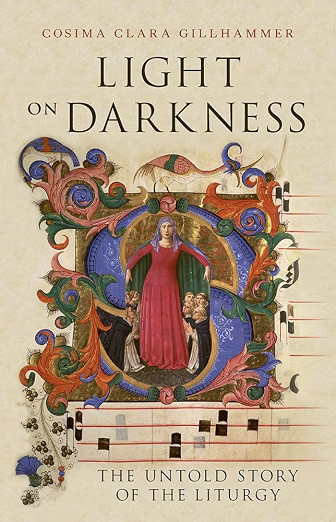
“Light on Darkness” by Cosima Clara Gillhammer
“Ritual and iconography create context for telling a new story—a departure from the old, but the bridge from old to new is provided in the reshaping of the ritual or icon."
Share this:

“The Greatest Story Never Told,” by Leonard Sweet
All of us who have the Spirit of Christ share in the passion the Lord has for earth, for people, for each other. We share in spiritual knowledge and understanding, we share in, as Sweet puts it, the upward works of piety that include the sacraments, prayer, and scripture, and we share in the outward works of piety, of grace, mercy, and charity.
Share this:

“The God of Story,” by Daniel Schwabauer (Part 2)
If God is for real, and God's word still speaks, then we can be confident God's power will also continue to be at work. It is the Holy Spirit Who does the convicting, the enlivening, the softening, the quickening, the restoring, and the raising up. None of that is mine.
Share this:

“The God of Story,” by Daniel Schwabauer (Part 1)
What is the real reason for a good story? To be a vault that safeguards truth in such a way each new hearer discovers the truth for themselves (pp 29, 50, 59).
Share this:


“Jesus Imagination,” by Leonard Sweet (Part 2)
At a certain point in the second half, it felt as though I were reading an autobiography in the form of a devotional diary. It felt like sitting with Len Sweet early in the morning (or maybe late at night), when time slows down and we are in that mystical place between heaven and earth where inspiration and revelation fill us to overflowing.
Share this:

“Jesus Imagination,” by Leonard Sweet (Part 1)
What I have been calling quantum thinking, moving from the binary "not this but that" to the quantum "yes this and also that" Sweet entitles "sacred tensions," in Chapter 14, and Kierkegaard calls paradox the thinker's passion, and that is the perfect way to begin.
Share this:


“Personal Knowledge,” by Michael Polanyi (Part 2)
Intuitive and creative thought can only thrive in a free society. Only human beings were able to develop signs and symbols that could record and convey ideas, which made it possible for our intelligence to grow. We are still growing. It takes all of us to know and share the truth, and to continue to find meaning.
Share this:

“Personal Knowledge,” by Michael Polanyi (Part 1)
Polanyi gives his thesis statement a number of times, but I thought this one was fairly straightforward and succinct: “… The whole process of discovery and confirmation ultimately relies on our own accrediting of our own vision of reality” (p 130). This is true of faith and belief as well.
