
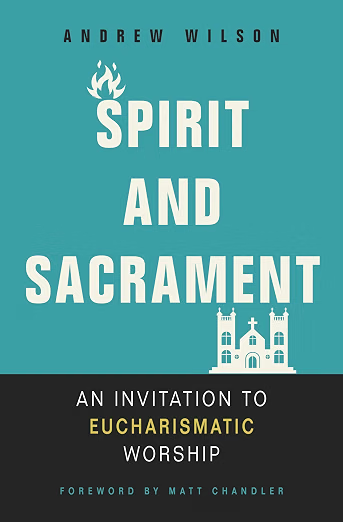
I am currently in a doctoral program, studying semiotics—cultural symbols—which requires a great deal of reading. Probably the greatest benefit of an education is the wise guide (teacher) who can give a curated tour of the best there is in any given subject, and such is the case with this program. Dr. Leonard Sweet has opened the door to an entire world of scholars and theologians who look beneath the surface of things and reveal mysteries. Now I would like to open that world to you.
Our church is very like the contemporary evangelical format Andrew Wilson describes. Anything “formalist” is anathema, with an emphasis on singing and teaching (14–15, 80). A number of years ago, one more element was added to the announcements time—taking prayer requests. We have now expanded that to praying together.
Worship
We celebrate the Eucharist once a month, when we keep an open mic for that time, inviting people to bring a song, a Psalm, a word from the Lord, a poem, really anything the Lord has given them for us. Some Sundays, that time is filled with rich sharing, other Sundays only one or two people speak. I would personally love to celebrate the Eucharist every time we gather. In fact, I would love to re-introduce the the Apostle’s Creed, the Lord’s prayer, a time of confession, and a grace or benediction to our time together, in keeping with the ancient church’s practice. It is astonishing how resistant people are to that liturgy.
Richness of the Eucharist
Reading this book through the lens of my transfiguring experience of worshiping in a highly liturgical church in Cambridge, England, I really get what Wilson is saying about the richness of liturgy. We experience God, and God also experiences us through both the physical sacraments and the exercising of our spiritual gifts (21). What could bring God more pleasure than our embodied, Spirit-filled, overflowing worship in song, prayer, prophecy, healing, words, the eating of Christ’s body, the drinking of His cup, and all the rest?
The gospel of John did not include this part of the Last Supper in his Gospel, but he did include the wine (wedding at Cana, John 3) and the bread (feeding of the five thousand, John 6). Jesus’s cup is lavish, it is the best wine, it is the joyous celebration of union with Him, as well as remembrance of what He has done and is doing that we may be united with Him forever.
And the bread is heavenly, containing all we need to be nourished and strengthened.
“Moses did not give the bread from heaven to you, but rather my Father gives the true Bread from Heaven to you: for the Bread of God is that which comes down from heaven and which gives life to the world.”
Jesus, to the crowd who had followed Him, in John 6:32–34
It was a new aspect of the bread that would not perish. Not only would the bread itself last into eternity, but all who ate of it would also last into eternity. It was as though the prophet were speaking of the very Tree of Life, in the Garden of Eden, the precious gift God had forbidden to all humanity after the great disaster of humankind’s rejection of God’s sovereignty. And Jesus took it even further, saying,
“The one who crunches-and-gnaws on my flesh and drinks of me the blood has life eternal, and I also will raise that one up, the last day.
“For my flesh is true food, and my blood is true drink.
Jesus, to the religious authorities, in John 6:53–55
Yup. Jesus could have used a daintier word for eat, like esthio, or phágo, or édo, or vivrósko. In fact, Jesus does use the word esthio earlier in John 6, but then He leans in, in John 6:54 with the verb trōgō. The centrality of the Eucharist for the people of Christ is as unquestionable as baptism (63)
Gnostic Worship
I have been putting into practice Wilson’s call to gratitude, concentrating on enjoying— trōgō—to the last morsel every good gift God gives (34). Wilson enjoins us to pursue the gifts in obedience to Paul’s exhortation to the Corinthian church. This is more than “if wishes were nickels,” this is an assertive, passionate quest to build up the whole church through God’s divine power (58, with the evangelical response on 119).
I had to think about the Gnostic influences so strong in USAmerican evangelicalism. I think Wilson is not wrong. This is why online church (thanks to the Covid boost) remains a thing, I think. If all “going to church” is, is watching those on stage perform the songs and preaching, well … it certainly does not need me. The show will go on whether I am there or not. And anyhow, I can watch church in my bathrobe, with a donut and a cuppa coffee, play games on my phone, and go to the bathroom, plus remain a churchgoer (70). All good, right?
The earthy, embodied, truly corporate, Holy Spirit-interactive worship Wilson describes is not even comparable with television worship.
Shaped by Our Loves
The whole section on being shaped by our loves rather than our knowledge is brilliant insight (77). We need the habits of heart that experience the sacraments and what I might call “high church” liturgy (80–87). This keeps us grounded in the church’s whole story arc, rather than veering off into our own “twenty-first-century zeitgeist” (87). In fact, Wilson’s discussion of the west’s waning belief in the devil, but also angelic beings, and the supernatural in general, was quite apt. That is all part and parcel with our enculturation, and not biblical (96–101).
Wilson’s call to catholicism is noted. He uses a relatable analogy of doctrine and practice written in pencil, ink, or blood in trying to keep churches from hawking their distinctives but rather seeking charity and joy towards each other (135). That said, there is an appeal to the newcomer to know what a particular church’s distinctives are, because the ink and the blood, well, that matters.
Apart from the patriarchal and slightly tone-deaf beginning, this book is a good read.

