
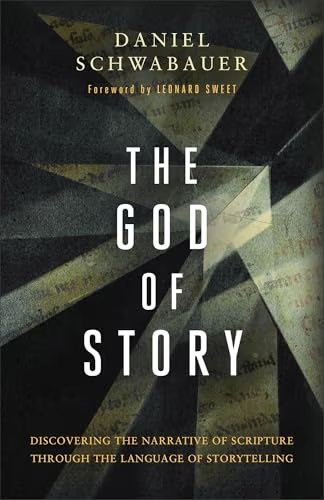
I am currently in a doctoral program, studying semiotics—cultural symbols—which requires a great deal of reading. Probably the greatest benefit of an education is the wise guide (teacher) who can give a curated tour of the best there is in any given subject, and such is the case with this program. Dr. Leonard Sweet has opened the door to an entire world of scholars and theologians who look beneath the surface of things and reveal mysteries. Now I would like to open that world to you.
The Weakness of Good
It had been a particularly hard day. I was tired and hurt, and feeling even more weary inside. That night, as I leaned against Jesus, I said, “Good can’t win. Good has to follow the rules. But bad doesn’t care, it never follows rules. Bad will always win.” I could feel Jesus’s arm around me, and his warmth. “But we have to try, don’t we,” I said, whispering. “Good keeps trying until we die, because that’s what good is.” I was six years old.
I did not realize good wins—God wins—until years later, when I read the Bible through to the end for the second time. I was in my early teens, and this time, reading Revelation 20, the penny dropped. Death and Hades will be thrown into the lake of fire, the second death. That sounded pretty much like a permanent win to me. Knowing that changed everything. But then again, it did not. Good may not win in my lifetime. But every time good tries, that counts.
I have never, in all these ensuing years, heard or read anyone else understanding this truth … until now.
“Principled power can never be as extreme as its unprincipled counterpart because it will always be limited by the boundaries of virtue”
Daniel Schwabauer, The God of Story, 67
The Unbounded Power of God
That is the truth.
Though God’s power is unbounded, the power of evil is unboundaried. Reading this sentence has telescoped my focus on Schwabauer. He knows things, and he can articulate them. I suspected as much when he spoke of the deus ex machina in Little Red Riding Hood (a story that terrified me as a child. I wondered why there were so many of these bloodthirsty horror stories illustrated for little children to read, I do not know, all by themselves in the library. Adults can be such monsters). I felt my heart stop as I read,
“When we had our run-in with the wolf, there was nothing we could do about it either. It took a woodcutter breaking into our life to pry us from the jaws of destruction”
Daniel Schwabauer, The God of Story, 32
My six-year-old self would also have said, when you get eaten by a wolf, there is no coming back. If you survive it, you will never be a little girl again. But the woodcutter will rescue you anyway, and will take care of you.
Discovering the Narrative of Scripture Through the Language of Storytelling
What is the real reason for a good story?
To be a vault that safeguards truth in such a way each new hearer discovers the truth for themselves (pp 29, 50, 59). A good story is told abductively, so that we are drawn in by the particular (p 51). A good story, a timeless story, overlaps our own experiences in reality (p 95).
Exegesis of Genesis 1–3
A good story shows the tree of life and the tree of the knowledge of good and evil side-by-side (p 78). I get twitchy, these days, when someone is about to explain anything from Genesis 1–3. Unless you have really spent some quality time in that beautiful innocent world, and sat in ashes of mourning over the serpent’s successful attack … Anyway, I braced myself. But his treatment of the two trees was excellent, and I am grateful.
At first, I wanted to resist the idea that Hansel and Gretel was a bad story, but I could not. Schwabauer is right. A good story includes ubuntu, where self is sacrificed for others. A good story is a Jesus story.
“I am not me without you. And if I’m not me without you, then I cannot sacrifice you without sacrificing myself. I cannot choose power over principle without becoming something less than human, something antithetical to tov: something false and ugly and evil”
Daniel Schwabauer, The God of Story, 70
A lot clicked into place, too, reading about the two basic formulas for story, and how the Tree of Power versus Principle is the better story (p 82). [As an aside, in conversation about this book, Professor Leonard Sweet felt that “Presence” might have been a better choice of word than “Power,” for Jesus’s presence, God’s presence, includes all of Who God is).
Exegesis on the Book of Job
I finished with Schwabauer’s masterful treatment of the book of Job. I have my own thoughts about Job, and particularly (no surprise) about Job’s wife. Consider me blown away when I read what I thought were my ideas that I had never heard before and told back to me far better than when I first thought them.
Who does that!
Plus, plus, Schwabauer had insights that were new to me, and they are rock solidly sound. Elihu! That is brilliant. And why God would not just smash Satan. That would have been the Tree of Power versus Power, a less-than-God story. Also worth gold was the better translation of God’s response to Satan. It does not change how I tell the story of Job’s wife, but it does create a much more holistic context for what she had to say, and how that all played out for Job.
Personal Betterment
There are so many good things to say about this book, and I am reading with a voracious appetite. I’ve been asking God for a book that will teach me how to write a good story, a sweeping story, that tells the truth. This is that book. And get this! He gives adult writing courses!
If I approach this as a pastor/teacher
… it takes me to how I teach. Right now, when I give the message, it is interactive, asking people to get inside the story and look around. Our small assembly is pretty responsive, and most of the time I come away with new insights they have given me. I would like to continue learning how to do this well.
Is it possible to deliver a sermon that tells this kind of story (in 30 minutes) that entertains, conceals the theme in the actors and events, and also reveals truth in the same way? Schwabauer talked about the value of parables, and how they make us ask questions (if we care to know). Or is a sermon not the right venue? What do you think?
If I approach this as a theosemiotician
… then it is in learning how to recognize the elements of a Good Story and a Bad Story, just as it was shown to us in Cinderella (good) and Hansel and Gretel (bad). Recognizing these elements makes the theosemiotician able to rightly divide the stories our culture is gripped by right now, to reveal what is good and to warn about what is bad. What is good comes from heaven (at least according to James, anyway), and these Good Stories can lead to Jesus.
What Good Stories or Bad Stories are trending right now?

